

Cybersecurity remains a top priority as organizations worldwide face evolving threats and regulatory changes. November 2025 brought significant developments in the Asia-Pacific (APAC) region and globally, from legislative updates to major breaches and outages.
The month highlighted growing pressure on SMEs or large enterprises to strengthen cyber readiness, improve threat intelligence investments, and modernize risk governance as attackers grow more coordinated and AI-driven.
Here are the five most impactful stories you need to know, from law changes to major breaches and outages.

Bitsight announced a 50% year-over-year growth in APAC through Q3 2025, driven by heightened demand for cyber risk intelligence. At the Luminate Exchange Japan 2025, experts highlighted Japan’s elevated rates and the growing sophistication of Advanced Persistent Threats (APTs) and that
Japanese organizations averaged 2.8× more total vulnerability findings per asset versus a global baseline. Organizations are increasingly investing in intelligence-led resilience to combat these risks. Overall, the rise in cyber risk intelligence usage shows that APAC are moving away from reactive methods and leaning on data-driven insights to anticipate cyber-attacks before they become business disruptions.
China approved amendments to its Cybersecurity Law, effective January 2026. The changes introduce AI governance, mandatory safety certifications for network equipment, and expand the law’s extraterritorial from activities by overseas parties that harm critical information infrastructure in China to any activities by overseas parties that harm China’s cybersecurity.

Noncompliance fines have increased for Critical Information Infrastructure Operators (CIIOs) from RMB 1 million (approx. USD 141,000) to RMB 10 million (approx. USD 1.41 million) and those for non-CIIOs from RMB 100,000 (approx. USD 14,100) to RMB 2 million (approx. USD 282,000), as well as holding first-time violators liable to fines. Also, network operators failing to take required measures regarding illegal content (such as ceasing transmission, removal, record preservation and reporting to authorities) will face fines of up to RMB 10 million (approx. USD 1.41 million.
These changes have far-reaching implications for domestic firms, multinational corporations, and foreign technology providers operating in China. Businesses must strengthen compliance frameworks, re-evaluate data pipelines, and ensure AI-driven services meet the new transparency standards.
The amended law highlights China’s broader strategy to regulate AI technologies and mitigate risks associated with automated decision-making, surveillance systems, and cross-border data flows.

On 18 November 2025, a global outage caused disruptions to services like X formerly known Twitter, ChatGPT, Canva, banking platforms, and enterprise SaaS tools. The root cause was triggered by a change to one of Cloudflare’s database systems’ permissions which caused the database to output multiple entries into a “feature file” triggering cascading failures used by Cloudflare’s Bot Management system.
The incident served as a wake-up call for businesses to implement redundancy strategies, multi-region failovers, and continuity plans that reduce reliance on singular external service providers.
DoorDash disclosed a breach following a social engineering attack that compromised employee credentials. Exposed data includes names, emails, phone numbers, and addresses across multiple regions.

According to the company no financial or highly sensitive information such as Social Security Numbers, government-issued IDs, driver’s license info, or payment card data was accessed. DoorDash also stated they have no indication the stolen contact data has been misused for fraud or identity theft.
The incident reinforced the importance of vendor risk management, continuous audits, and third-party monitoring as essential components of modern cyber security programs.

On 25 November 2025, Singapore’s Ministry of Home Affairs (MHA), via the Singapore Police Force, issued implementation directives under the Online Criminal Harms Act.
The directives require Apple and Google to prevent accounts or group chats on iMessage and Google Messages from using names that spoof government agencies (e.g. the “gov.sg” sender-ID), or to filter out such messages. Scammers had begun impersonating government agencies using these platforms, exploiting the fact that encrypted messaging services lacked the SMS-sender-ID safeguards. Reported impersonation-scam losses reached S$126.5 million in the first half of 2025 across all such scams; the number of reported cases nearly tripled compared to the same period in 2024.
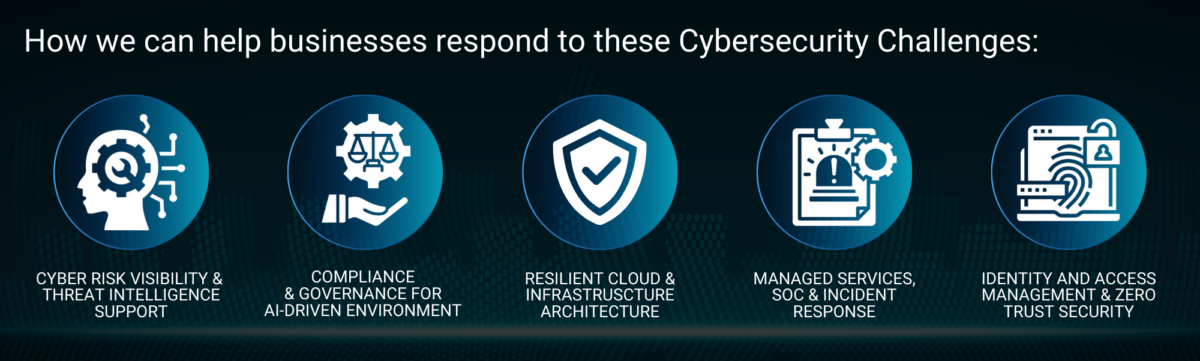
How Data Connect Technologies Helps Businesses Respond to These Cybersecurity Challenges
Given the array of threats and vulnerabilities exposed in November 2025, many businesses, especially across APAC need a trusted, comprehensive ICT partner to strengthen cyber defenses, ensure resilience, and maintain compliance. That’s where Data Connect Technologies comes in.
- Cyber Risk Visibility & Threat Intelligence Support
Data Connect Technologies offers cybersecurity assessments, vulnerability scanning, and continuous threat-intelligence monitoring helping enterprises detect exposures early and build intelligence-driven defenses. This aligns directly with the growing regional demand for risk scoring and proactive security highlighted by the Bitsight data.
- Compliance & Governance for AI-Driven Environments
As regulatory frameworks tighten (e.g., China’s AI cybersecurity law updates), Data Connect Technologies provides governance, risk & compliance services, data-governance policy design, and AI-system security assessments helping businesses navigate new regulations while maintaining digital operations.
- Resilient Cloud & Infrastructure Architecture
Data Connect Technologies specializes in designing and deploying scalable, secure, and redundant IT infrastructure including cloud, virtualization, storage, backup, and network solutions which help firms avoid single-provider dependencies and reduce risk of outages like the Cloudflare incident.
- Managed Services, SOC & Incident Response
With a 24x7x365 Security Operations Center (SOC) and managed-service offerings, Data Connect Technologies supports real-time threat detection, patch & configuration management, endpoint security, and incident response critical capabilities given the social-engineering risks exploited in breaches like DoorDash’s.
- Identity & Access Management and Zero-Trust Security
To counter impersonation risks and protect user identity relevant in an era of increasing scams and identity-based attacks Data Connect Technologies offers identity federation, directory services, access control, and zero-trust frameworks, helping businesses secure digital identities and communications.

What November 2025 Means for Future Cyber Security Strategies
The events of November 2025 emphasize the growing importance of intelligence-led defense, resilient cloud designs, and stronger vendor oversight. As threats scale and regulations tighten, APAC enterprises must adapt by integrating AI-driven detection, reinforcing multi-cloud strategies, and prioritizing board-level cyber planning. Heading into 2026, organizations should expect adversaries to target cloud workloads, virtualization layers, AI models, and third-party ecosystems with greater precision. Building this forward-looking resilience will require cross-functional collaboration across security, operations, finance, and governance teams.
Key Takeaways
- Invest in Threat Intelligence: APAC organizations are leading the way others should follow suit.
- Prepare for Regulatory Changes: China’s AI provisions may set a precedent for other regions.
- Strengthen Cloud Resilience: Outages like Cloudflare’s show the need for redundancy and robust incident response.
- Train Employees Against Social Engineering: Human error remains a top attack vector.
- Secure Virtual Infrastructure: Ransomware groups are expanding their targets don’t leave VMs unprotected.
- Data Connect Technologies offers a full suite of managed services, cloud & infrastructure design, SOC & security operations, compliance and identity-management solutions aligned with the threats highlighted in these incidents.
Final Thoughts
November 2025 proved to be a transformative period for APAC and global cyber security. From major outages and ransomware expansions to regulatory shifts and rising intelligence investments, the month’s developments signal a new era of accelerated cyber risk.
These cybersecurity developments highlight a clear trend: attackers are innovating, and regulators are responding. Organizations must adopt proactive strategies, combining technology, policy compliance, and human awareness to stay ahead.