

Cybercriminals no longer rely on broken grammar, suspicious links, or poorly designed emails. Today’s phishing attacks are intelligent, adaptive, and frighteningly convincing. Artificial Intelligence has transformed phishing from a numbers game into a precision-targeted psychological weapon.
At Data Connect Technologies, we believe organizations must understand not just what AI-powered phishing is but how it thinks, adapts, and evolves.

Traditional phishing relied on volume, attackers sent thousands of generic emails hoping someone would click.
AI-powered phishing is different.
It learns from social media, company websites, breached databases, public records, and even communication styles. It studies behavior patterns, analyzes tone, and generates context-aware messages in seconds.
The result? Personalized attacks at scale.
Let’s break down the major forms of reshaping the threat landscape.
TYPES OF AI-POWERED PHISHING
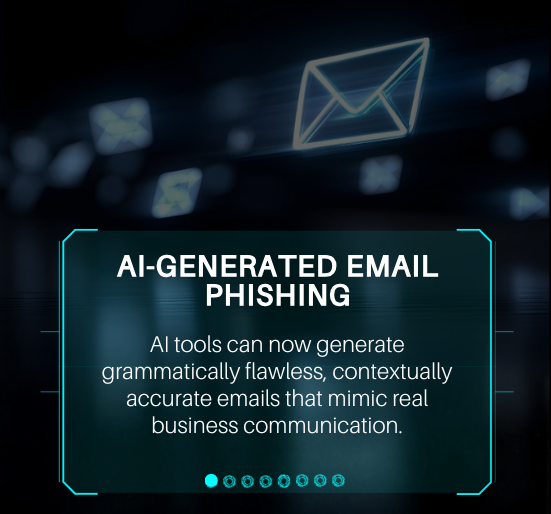

Unlike old phishing emails filled with typos, AI-generated emails:
- Match company tone and branding
- Reference real projects or events
- Adapt to the recipient’s role
- Bypass basic spam filters
An AI system can scrape LinkedIn data, analyze a company’s communication style, and craft a believable “invoice correction” email in seconds.
Attackers can create:
- Fake executive video calls
- Fabricated investor meetings
- Manipulated media statements
In some documented cases, finance departments approved large transfers after participating in deepfake video meetings where every “participant” appeared real.
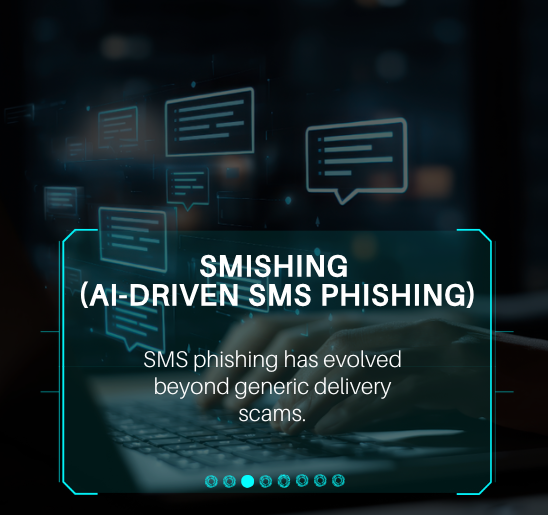

AI-powered smishing:
- Uses local language dialects
- Personalizes messages with names and contextual details
- Mimics banking or government alerts
- Adapts responses in real time
Because SMS feels more immediate and personal than email, AI-driven smishing exploits human impulse. Short, urgent messages leave little time for verification.
AI can replicate a person’s voice using short audio samples from:
- YouTube videos
- Conference recordings
- Voicemails
- Social media clips
Imagine receiving a call that sounds exactly like your CEO requesting confidential payment. Voice trust is deeply psychological. AI exploits that trust.


AI enhances these attacks by:
- Mimicking executive writing patterns
- Replicating digital signatures
- Generating urgent financial requests
- Simulating confidential board communications
With AI, attackers can impersonate a CEO requesting an emergency wire transfer using phrasing nearly identical to their real communication style.
When authority and urgency combine with AI precision, even experienced professionals can be deceived.
Attackers deploy fakes:
- Banking support bots
- IT helpdesk portals
- HR onboarding assistants
These bots:
- Answer questions convincingly
- Guide victims step-by-step
- Collect login credentials
- Extract multi-factor authentication codes
Because conversations feel interactive and dynamic, victims lower their guard.

Instead of manually researching one executive, attackers now automate intelligence gathering. AI tools collect:
- Recent press mentions
- Social media activity
- Organizational hierarchies
- Public financial disclosures
The result? Highly personalized emails that feel internally authentic.
AI tools can:
- Create realistic fake profiles
- Automate relationship-building
- Analyze engagement patterns
- Launch trust-based attacks
Instead of immediate attempts, AI nurtures digital relationships building familiarity before exploiting it. This long-game strategy dramatically increases success rates.
Here are five of the most impactful breaches and outages recently making headlines:
- Bitsight reports 50% growth in APAC as organizations increase investments in cybersecurity amid rising cyber risk awareness.
- China amends its Cybersecurity Law to include provisions addressing Artificial Intelligence, signaling stronger global regulation around emerging technologies.
- Cloudflare global outage disrupts major platforms, highlighting the growing dependence on cloud infrastructure and the need for resilient systems.
- DoorDash confirms a breach exposing millions of records, underscoring the importance of securing customer and operational data.
- Singapore government orders Apple and Google to strengthen measures against impersonation scams, reinforcing the urgency to protect users from digital fraud.
- IBM X-Force reports 44% surge in exploitation of public-facing applications as supply chain and identity attacks intensify.
- Eye Security’s 2026 State of Incident Response Report shows that cyberattacks on companies are increasingly going undetected, and the damage occurs within minutes. According to the report, attackers are now focusing less on hacking systems and more on exploiting existing access points.
- 2026 Unit 42 Global Incident Response Report — Attacks Now 4x Faster! This year’s Unit 42® 2026 Global Incident Response Report analyzed over 750 major cyber incidents across every major industry in over 50 countries to reveal emerging patterns and lessons for defenders.
These incidents connect closely with what we highlighted in CYBER SECURITY NEWS & CYBER ATTACKS: APAC and Global Highlights for November 2025 – Data Connect Technologies Pte Ltd, where the rise of AI-Powered Phishing attacks continues to be one of the most concerning threats.

1. It scales personalization.
2. It reduces human error from attackers.
3. It adapts in real time.
4. It bypasses rule-based security filters.
5. It exploits behavioral psychology more effectively.

The next phase of AI-powered phishing is automation without human oversight.
Emerging risks include:
- Self-learning phishing campaigns
- AI systems that adjust tactics after failed attempts
- Real-time sentiment analysis during live attacks
- Autonomous targeting based on financial vulnerability
Phishing is evolving into an intelligent ecosystem.
How Organizations Can Respond
At Data Connect Technologies, we emphasize a multi-layered defense approach:
1. AI vs AI Security
Use AI-powered detection systems that analyze behavioral anomalies, not just keywords.
2. Zero-Trust Communication Policies
Verify financial or sensitive requests using secondary channels.
3. Executive-Level Awareness Training
Whaling and deepfake attacks require top-down cybersecurity culture.
4. Multi-Factor Authentication (MFA) Reinforcement
But also educate teams about MFA fatigue attacks.
5. Continuous Threat Simulation
Conduct AI-driven phishing simulations to test real-world readiness.

FINAL THOUGHTS:
Artificial Intelligence has fundamentally changed the nature of phishing. What was once easy to spot is now intelligent, adaptive, and deeply personalized. Email, SMS, voice, video, chatbots, and social platforms have all become entry points for AI-driven deception.
The reality is clear: phishing is no longer just a technical threat. It is a behavioral and psychological attack powered by automation and machine learning. Organizations that rely solely on traditional defenses will find themselves outpaced.
At Data Connect Technologies, we believe cybersecurity must evolve as fast as the threats it faces. Combating AI-powered phishing requires AI-driven detection, zero-trust verification, executive awareness, and continuous testing. The goal is not just to block attacks, but to build resilience at every level of the organization.
In an era of smarter scams, preparedness is the new perimeter.