

Artificial Intelligence has moved beyond being a futuristic concept, it is now a strategic business tool. From automating repetitive processes and generating insights from massive datasets to enhancing customer service through intelligent chatbots, AI is transforming how organizations operate.
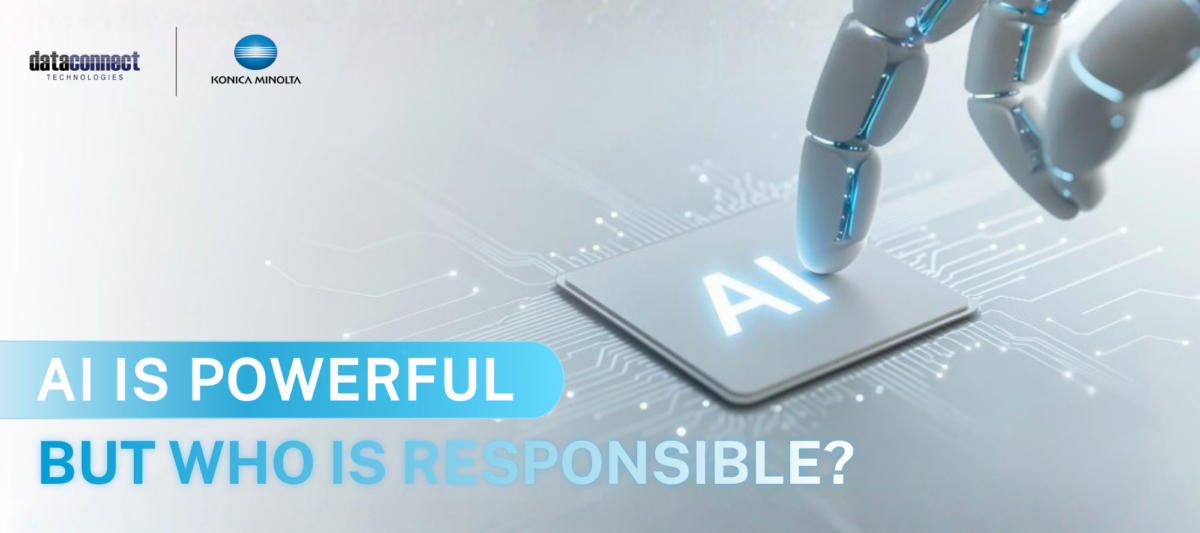
But as AI becomes more capable, one critical question continues to emerge:

The answer isn’t as simple as “the AI.” Behind every AI model are people, processes, and governance frameworks that determine how technology is designed, trained, deployed, and monitored. While AI can accelerate innovation, responsibility always remains with the organization that uses it.
AI Doesn’t Replace Accountability
AI systems learn from data and patterns. They can recommend actions, generate content, predict outcomes, and even interact with customers in natural language. However, AI does not possess judgment, ethics, or accountability.
Businesses remain responsible for:
- Ensuring AI decisions align with business objectives
- Protecting customer and organizational data
- Monitoring model performance and accuracy
- Preventing bias and unintended outcomes
- Maintaining regulatory and industry compliance
AI should support human decision-making—not replace it.

An AI model is only as good as the data it learns from.
Poor data quality, inconsistent records, or incomplete information can produce unreliable outputs. Organizations often focus on selecting the latest AI tools while overlooking the importance of building a strong data foundation.
Responsible AI begins with:
- Reliable data pipelines
- Well-governed data assets
- Consistent data quality
- Secure data management
- Clear data ownership
Without these fundamentals, even the most advanced AI models can deliver misleading insights. Research in data-centric AI consistently highlights that improving data quality is often more impactful than simply building more complex models.

Many organizations are eager to adopt AI, but fewer invest in AI governance.
Effective governance ensures AI systems remain transparent, secure, and aligned with business goals throughout their lifecycle. It involves defining policies for data access, monitoring model performance, documenting AI decisions, and ensuring ongoing compliance.
Rather than asking, “Can we implement AI?”, organizations should also ask:
- Should AI make this decision?
- Who validates AI-generated outputs?
- How do we detect errors or bias?
- How do we improve the model over time?
Responsible AI isn’t about slowing innovation—it’s about making innovation sustainable and trustworthy.

AI delivers the greatest value when it is integrated into a well-designed data strategy.
At Data Connect Technologies, our Data & AI Solutions help organizations transform raw data into meaningful business intelligence through:
- Data engineering and integration
- Analytics and Business Intelligence dashboards
- AI and Machine Learning solutions
- Predictive analytics
- Large Language Models (LLMs) and Natural Language Processing
- AI-powered chatbots and voicebots
- MLOps and model performance monitoring
- Data governance and quality management
These capabilities help businesses move beyond experimentation and implement AI solutions that are scalable, secure, and measurable. DCT also offers AI-powered solutions such as PASCAL and ALLY, designed to enhance customer engagement through intelligent chat and voice interactions while integrating seamlessly into business operations.

AI is no longer a competitive advantage on its own. What differentiates successful organizations is
HOW RESPONSIBLY THEY IMPLEMENT IT.
The companies that will thrive are those that combine advanced AI capabilities with strong governance, trusted data, and human oversight. Technology can automate tasks, uncover opportunities, and improve decision-making but accountability will always belong to people.
At Data Connect Technologies, we believe AI should empower organizations with confidence, not uncertainty. By combining intelligent AI solutions with robust data engineering, governance, and continuous monitoring, businesses can innovate responsibly while building trust with customers, employees, and stakeholders.

AI IS POWERFUL — but responsibility is what makes it truly valuable. The future of AI isn’t defined by technology alone,
it’s defined by how we choose to use it. Let’s build and use AI with integrity, purpose, and people at the center.